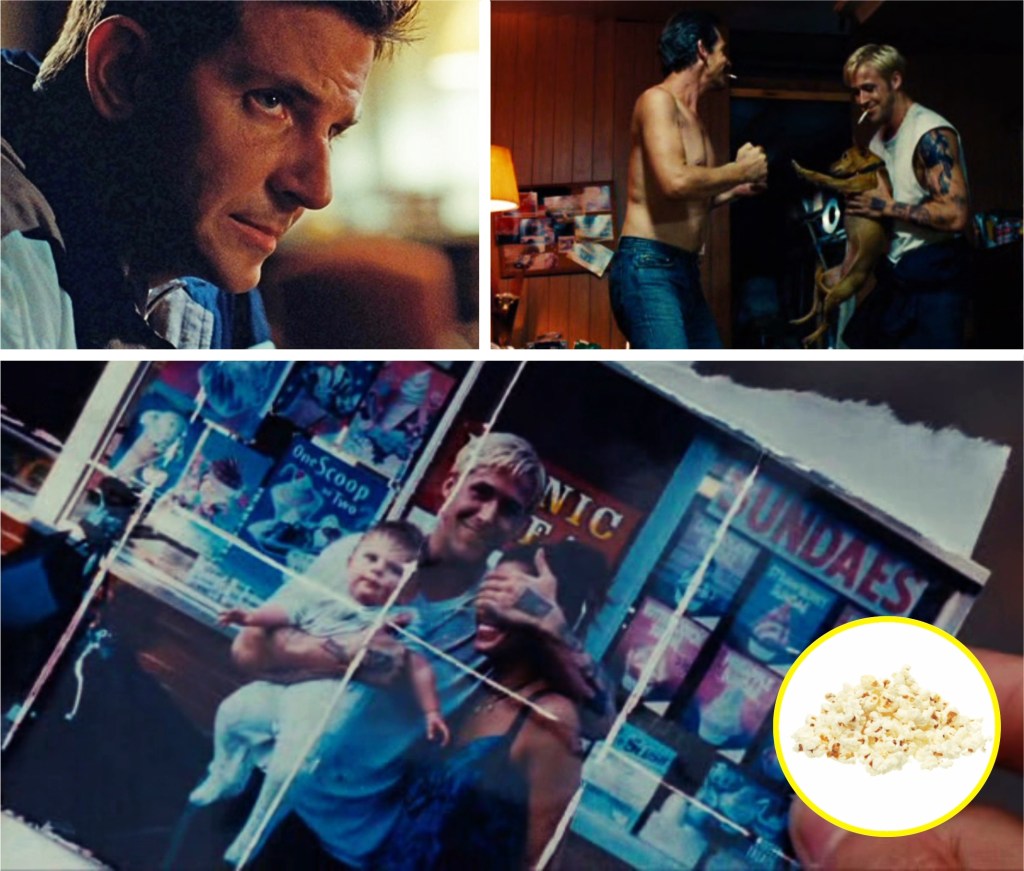
There are sort of spoilers but they are still the kind one preferably wants to avoid..
Before falling asleep yesterday, I contemplated on the things I wanted to say about The Place Beyond the Pines; needless to say, I couldn’t fall asleep for almost an hour. I kept thinking about the plot, the characters, the cinematography, the soundtrack and I was endlessly wondering how will I ever manage to express all the things going through my head. In a way, I’m still wondering but at this point, pushing back this review seems impossible.
The Place Beyond the Pines, simply put, is a story about fathers and the consequences of their actions which will influence their sons. What makes this story stand out is the way it is presented – there are three separate but intertwined acts focusing on different characters. In other words, The Place Beyond the Pines doesn’t just focus on one story, it presents two different lives connected by their collision which will eventually result in events taking place 15 years later. There’s no doubt that director/writer Derek Cianfrance, who’s Blue Valentine showed a very different take on love, tackles another complex story, the question is about whether the brave and unlikely choices in the narrative paid off in the end. Some might argue that it did not, but while I agree that the final act did present itself as the weakest among the three, the strength that The Place Beyond the Pines creates for me in the beginning could never be undermined. It’s a strong story that is brought on screen by an even stronger movie with amazing actors, an outstanding cinematography and a great soundtrack.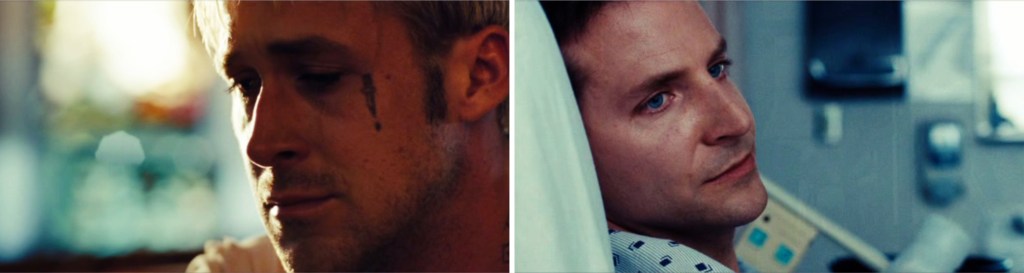

As the plot shifts the character-focus twice, the importance of a great cast is undoubtedly one of the key elements; luckily Ryan Gosling and Bradley Cooper do not disappoint. Gosling portrays Luke, the traveling stuntman, who suddenly finds out about the existence of his son and decides to quit his job. Though his intentions in the beginning seem good, the newly found friendship with Robin (Ben Mendelsohn) leads him to a path of robbing banks and his violent personality starts to surface. Still, Gosling’s ability to create sympathy for the bad guy is astonishing and one can’t help to root for Luke even when his actions are morally wrong. That skill is especially crucial for that moment where Luke’s plot and the events in the first act come to a sudden halt. The viewer is likely to experience a wide range of emotions when the first act ends and Avery (Bradley Cooper), a police office with a brand new son of his own, is presented as the new leading role. That first character perspective change is powerful, for me the first emotion was shock, then came sadness and finally the feeling of disappointment towards Luke as well as Avery. Eventually, the emotions and the fact that it was an unfair situation for Luke, seemed to create an intricate moral dilemma for The Place Beyond the Pines – was Avery the bad guy?, was Luke the good guy?… does it even matter?
Because of this, there are many obstacles for Cooper to overcome when Avery is first introduced, for one, he has to create an immediate connection with the viewer who by then has spent an hour getting to know Luke. Secondly, he has to be able to portray a character who’s actions can be justified, since he did make a mistake. And lastly, Cooper has to follow Gosling, which is not an easy thing to do. For me, the narrative change was surprising but it never felt wrong and it was almost comforting to see Cooper take the reigns from Gosling. The fact that the second act with Avery focuses on police corruption (a story line that features a very solid performance by Ray Liotta), was almost refreshing as it introduced a completely new plot element to the movie. With it, the moral dilemma, that surfaced from the collision between the first two acts, thickens and becomes even more complicated as we see more of Avery’s good side. By the end of Avery’s act, The Place Beyond the Pines has created a situation of bad vs. good, with a bank robber that has temper trying to do good for his son and with a police officer fighting corruption to redeem himself from making a fatal mistake. It all concludes in act three which takes place 15 years later between the sons of the two men who only met once and yet, that single moment shows to have great consequences in the end.
Third act, as I already said, felt the weakest but it certainly doesn’t mean it fails The Place Beyond the Pines; on the contrary, it ties everything together and presents the complexity of the movie with integrity. If one was to look for flaws, there is one – the strength of Gosling and Cooper was not really met by Dane DeHaan as Luke’s son Jason and Emory Cohen as Avery’s son AJ. Despite of this, the story itself is strong enough to carry the plot to its final culmination where Jason confronts Avery. Could the consequences have been more shocking and cruel in that scene – maybe, but as it was pointed out to me by a good friend, living with the knowledge that you made a mistake which eventually built your future, is far more painful.

The power of The Place Beyond the Pines doesn’t end with its story nor the actors; there is also the notable ease to the cinematography by Sean Bobbitt, who continuously works with Steve McQueen. Bobbitt has a good eye and the power of imagery is truly shown with in the first minutes of the movie but also with various other scenes from different acts which are presented through very meaningful parallels. One of the examples is the the image above; on the left, Luke is driving his motorcycle, on the right, his 15 year old son is riding his bike – they will never meet each other but (for me) the visual connection offers comfort that they are still somehow connected. There are many similar moments as well as details that connect throughout the movie but seeing those two scenes next to each other creates something special and I can’t seem to find the words to describe it. Though imagery is something I feel more comfortable with, there’s no way I’m going to look past the soundtrack. The Place Beyond the Pines has a great soundtrack because it not only features a piece by an Estonian composer (couldn’t leave out the nationality pride) but it ends with a song that is so fitting that I get goose pumps just thinking about it.
Still, like with every movie, there are opinions that go against everything I’ve said in this relatively long but hopefully interesting review. But, in spite of it, I’m hopeful that if one starts to piece apart The Place Beyond the Pines, the hidden meanings that are left to be discovered by Cianfrance and Bobbitt would change their minds. Yes, it’s extremely ambitious with its take on the narrative and its numerous perspective changes, not to mention the way it views the father figures, plus it does decline in the third act; but it’s still really good! Frankly, I’m a bit insulted when The Place Beyond the Pines is being undermined with descriptive words such as flimsy, a mess, melodrama and overrated – clearly these people have not seen enough young adult dramas to know what a flimsy melodramatic mess actually is. Then again, I’m not here to pick fights, so I’ll just say that I see Cianfrance’s ambition as interesting rather than a fault.


 METTEL RAY
Leave a comment